The model got the headline. The pattern is the product.
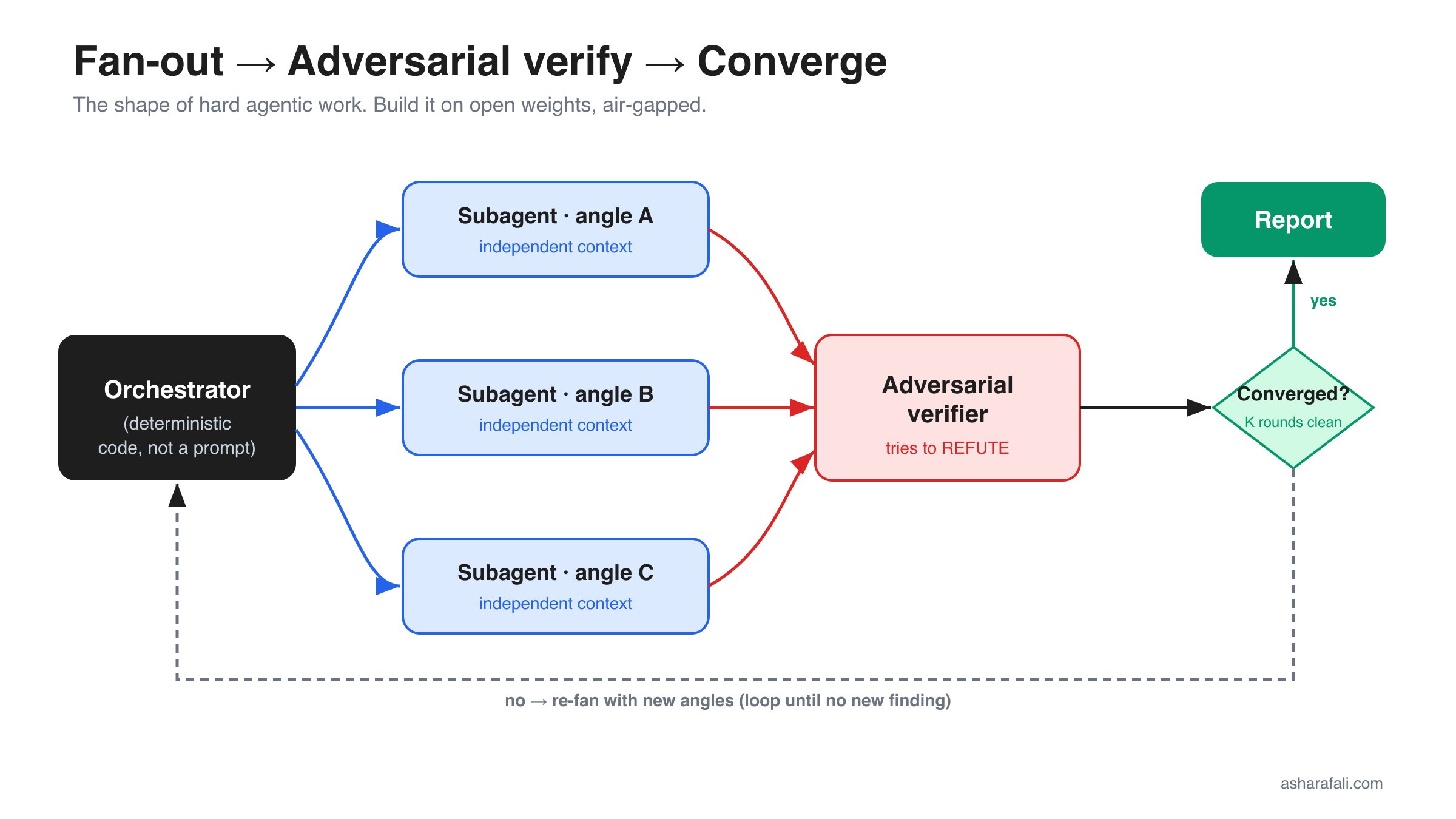
The headline last week was a new model. The lesson was an architecture.
Anthropic shipped Opus 4.8 on May 28. Buried under the benchmarks was the part that matters for anyone building agents: "dynamic workflows" — the model writes its own orchestration script, fans out tens to hundreds of parallel subagents, points adversarial agents at their findings to refute them, and iterates until the answers converge.
That's not a model feature. That's an architecture going mainstream. And you can build it on open weights, air-gapped, today.
Three things I'd tell anyone wiring up fan-out agent systems:
1. Fan-out is cheap. Convergence is the product. Spawning 100 subagents is one loop. Knowing when they've actually agreed — and aren't just echoing the same wrong context — is the hard part. Your orchestrator needs an explicit convergence criterion (K consecutive rounds with no new finding), not a fixed iteration count.
2. Adversarial verifiers beat more generators. Ten agents generating answers gives you ten plausible answers. One agent whose only job is to refute a finding kills the plausible-but-wrong ones. Spend your token budget on skeptics, not on a bigger crowd.
3. The orchestrator is code, not a prompt. Fan-out, barriers, retries, loop-until-dry — that's deterministic control flow wrapped around stochastic agents. If your "orchestration" is one giant prompt asking the model to coordinate itself, you don't have an orchestrator. You have a wish.
The trap: fan-out without a convergence test burns tokens forever — or worse, returns false consensus when every subagent inherited the same poisoned context. Diversity of angle is what makes the votes mean anything.
You don't need a frontier API to run this shape. LangGraph + a self-hosted 70B + a disciplined orchestration script gives you fan-out, adversarial verification, and convergence — inside your VPC, with a token bill that doesn't explode the moment the agent count does.
The model got the headline. The pattern is the product.